Refunds of invalidated IEEPA duties are being paid, while eligibility for some entries remains in litigation. This article sets out the position as of October 9, 2026, and the recognition, presentation and disclosure judgments it raises.

The tariffs at issue are duties imposed under the International Emergency Economic Powers Act (IEEPA). The Supreme Court invalidated them on February 20, 2026 (S5). About $166 billion in IEEPA duties was paid before interest (S6). Duties under other authorities are outside the refund pool (S18).
CBP administers refunds through the Consolidated Administration and Processing of Entries (CAPE) function in ACE. Phase 1 opened on April 20, 2026, for unliquidated entries and entries within 80 days of liquidation (S3). Refunds are not automatic. The importer of record, or a designated Form 4811 party, must file and be enrolled for ACH payment (S1, S7).
Phase 3 began on October 6 for finally liquidated entries. It is open only to plaintiffs with a pending Court of International Trade (CIT) case that gave CBP a valid importer number by July 30 (S2, S3). As of October 2, CAPE had accepted about $136.6 billion in potential and certified refunds, with $126 billion sent to Treasury for disbursement (S2).
Two matters are contested. The government is appealing the part of the CIT’s order that requires refunds to non-litigants on entries liquidated more than 80 days ago (S4). On October 8, the CIT certified a class of importers of record that paid IEEPA duties between February 1, 2025, and February 19, 2026, and have not sued. The order does not itself direct payment, and a government appeal is possible (S4, S5).
CBP states that refunds include interest under 19 U.S.C. § 1505, at a rate set by the IRS, and that CAPE reports separate principal from interest (S1). The sources reviewed did not identify a single filing deadline. No FASB standard addresses the subject. The AICPA reportedly issued nonauthoritative Technical Questions and Answers in September 2026 (S16), and the SEC’s Chief Accountant has stressed clear disclosure (S13).
Recognition turns on one question. Is the refund a gain, or the recovery of a cost already recognized? Practice supports both answers.
Under the loss recovery model, applied by analogy to ASC 410-30, an asset is recognized when recovery is probable under ASC 450-20. The amount is capped at tariff costs previously recognized (S8). Deloitte is reported to regard this model as the better analogy and the gain contingency model as an acceptable alternative (S10).
Under the gain contingency model in ASC 450-30, recognition waits until the gain is realized or realizable. KPMG, EY, RSM and CohnReznick are reported to lean toward this view. Realization is generally associated with CBP approving or acknowledging the amount, or with cash receipt (S10, S11, S12).
Status changes the analysis. A court order, a filed CAPE declaration, CBP acceptance, Treasury disbursement and cash receipt are distinct points. A filed claim may be a gain contingency in the period it is submitted (S11). Interest is assessed separately, may be recognized later than principal, and is typically presented as other nonoperating income (S8).
For multinational groups, IAS 37 allows a contingent asset to be recognized only when the inflow is virtually certain, a higher threshold than “probable” (S17). Some commentary also points to government grant accounting under IAS 20 as an analogy (S11).
Balance Sheet: A refund receivable is classified as current or noncurrent by expected settlement (S18). Tariffs were generally capitalized into inventory under ASC 330 as landed cost. For goods still on hand, a recognized refund reduces carrying value and flows through cost of sales on sell-through. For goods already sold, it reduces cost of sales in the period of recognition, and prior periods are generally not recast (S9).
Income Statement: The credit generally follows the line where the cost was recorded (S17). Gross margin in the recognition period may not be comparable to earlier periods. Interest is a separate line. Quarter-end timing can move amounts between periods, so the policy election and its application warrant close review.
Cash Flow Statement: Refund proceeds are generally classified consistently with the original tariff payments. Proceeds from selling refund rights to a funder are generally financing (S8).
Customers and Suppliers: Where tariffs were passed through, a customer may hold a right to a refund. That may be a change in variable consideration under ASC 606, and the adjustment need not be explicit or legally enforceable (S9). Amounts owed may also be consideration payable to a customer under ASC 606-10-32-25, with a possible timing mismatch against refund recognition (S15). Supplier reimbursement commitments require the same review. One public filer recorded a $37.6 million liability for amounts committed to vendors and partners (S10).
Tariffs paid were generally deducted through cost of goods sold or capitalized into inventory. A refund is generally taxable when received to the extent the duty produced a tax benefit, under the tax benefit rule (S19, S20). For goods on hand, the refund generally adjusts basis (S19). Interest is generally ordinary income (S20).
Under ASC 740, book recognition that precedes tax inclusion may create a temporary difference and a deferred tax effect. Net operating loss history, amended returns and accounting method questions may change the result. State treatment varies by jurisdiction, and a state-level proposal on tariff recoveries has been reported (S9). Each item above requires tax advice specific to the entity.
A refund inventory is the base control. It reconstructs payments by entry, tariff classification, country of origin, payment date and liquidation status, and separates IEEPA from other duties (S18). Customs entries and broker data should reconcile to the general ledger, and CAPE reports that separate principal from interest support that work (S1).
CBP pays only the importer of record or its Form 4811 designee (S7). The party that bore the cost may differ, so contracts and pricing records belong in the file. Missing ACH details delay payment. CBP reported 8,384 approved declarations unissued for that reason (S6).
The policy election, the evidence supporting each recognition, and the review path to the audit committee should be documented. ICFR design should cover status changes, such as an appeal outcome, that alter the analysis.
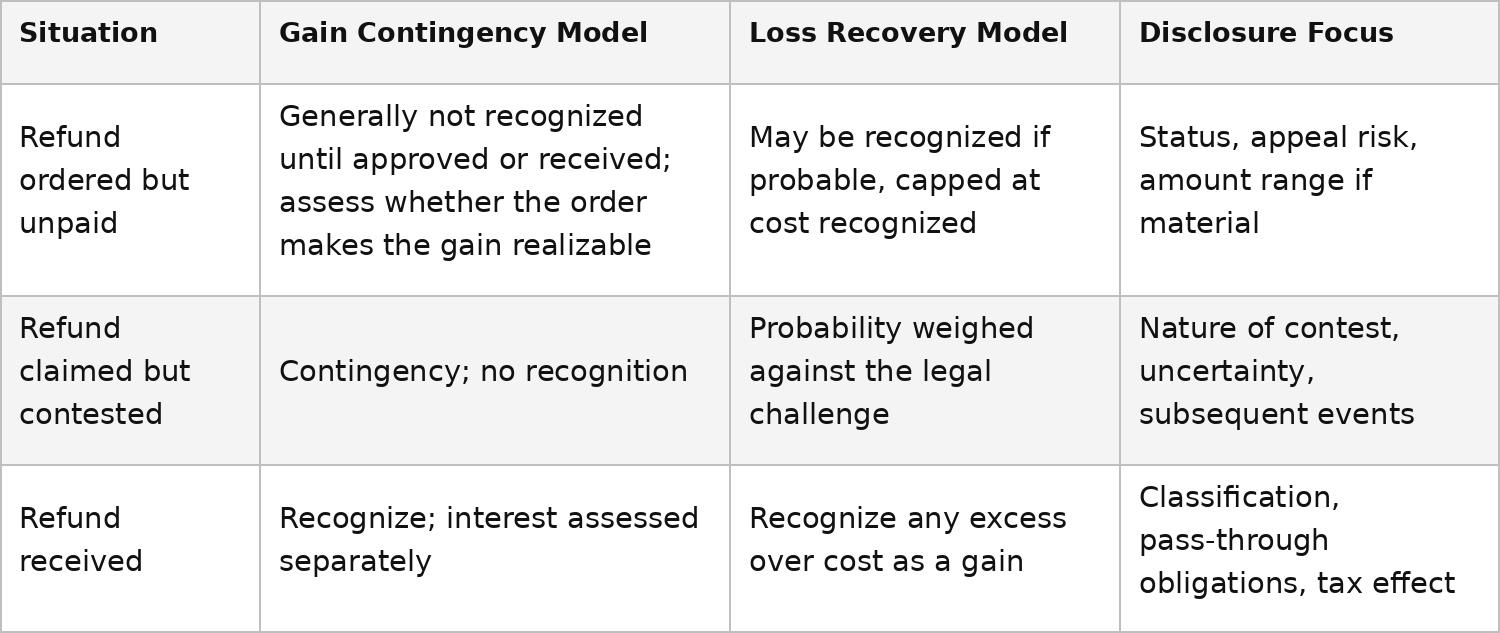
The table is illustrative and uses no amounts. Treatment depends on facts, the elected model and auditor review.

Wall & Genève is a finance and advisory firm serving investment banks, asset managers, hedge funds and broker-dealers. Precise work, handled with discretion.
Copyright © 2026 Wallandgeneve All Right Reserved.