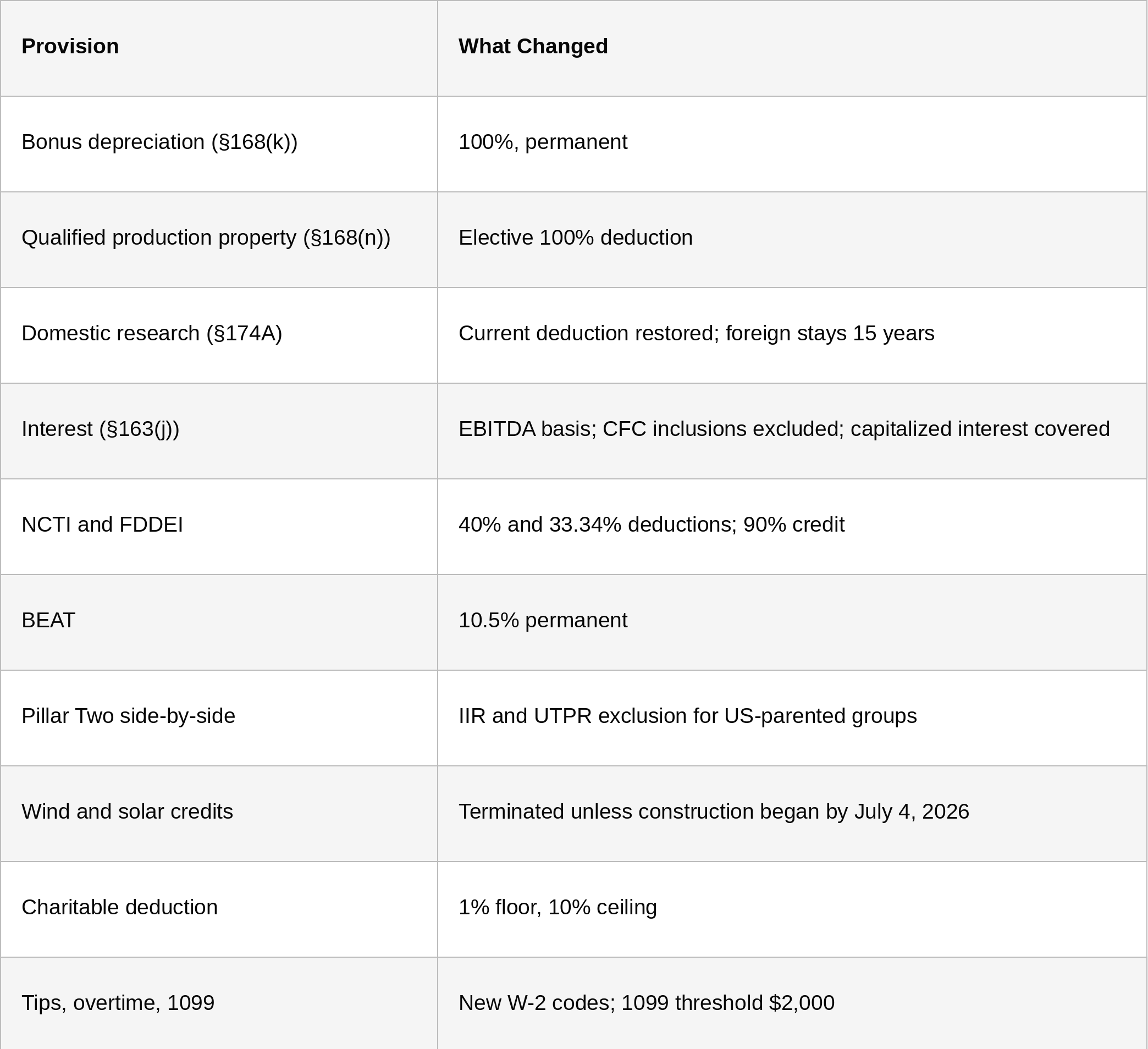
The One Big Beautiful Bill Act (Public Law 119-21) made 100% bonus depreciation and domestic research expensing permanent. It also restored an EBITDA-based interest limitation. The law revised the tax regimes starting in 2026. Interim guidance and proposed regulations now control many of these changes. The Pillar Two side-, by-side arrangement impacts how US-parented groups evaluate their minimum tax exposure.
For large corporations, the changes bear on cash taxes, effective tax rate, payroll reporting and entity structure, and a number of operating details remain unsettled.
The Act was signed on July 4, 2025. The House passed its original version on May 22, 2025. It moved through budget reconciliation. Most corporate provisions apply to tax years beginning after December 31, 2024 or after December 31, 2025, so calendar-year companies experienced one tranche of change in 2025 and a second on January 1, 2026.
Changed: 100% bonus depreciation under section 168(k) is now permanent; a new section 168(n) allows choosing to expense 100% of production property; section 179 is 2.5 million dollars with a 4 million dollar phase-out; domestic research is deductible again under new section 174A while foreign research continues to be amortized over 15 years.
Effective: Property that is bought and put into service after January 19 2025; section 168(n) construction that starts after January 19 2025 and before January 1 2029; section 174A applies to tax years that start after December 31 2024.
Guidance: Notices 2026-11 and 2026-16 are temporary; Revenue Procedure 2025-28 allows large taxpayers to recover domestic research costs from 2022 to 2024 in 2025 or over 2025 and 2026.
Implication: Modeling focuses on the elections for section 168(k). Section 168(n) and the choice of method, for section 174A which work with NOL limits and section 163(j). Section 179 does not have effect at this level.

Changed: Adjusted taxable income returns to an EBITDA basis; CFC inclusions (Subpart F, NCTI, §78 gross-up) are excluded from it; capitalized interest generally becomes subject to the limit.
Effective: EBITDA basis for tax years beginning after Dec. 31, 2024; other changes after Dec. 31, 2025.
Implication: Debt-capacity and covenant models warrant re-running for 2026, and CFC group elections lose most of their value.
Changed: GILTI is now net CFC tested income (NCTI): 40% deduction, 12.6% effective rate before credits, 90% credit. FDII is now FDDEI: 33.34% deduction, 14% effective rate. BEAT is fixed at 10.5%. Subpart F and NCTI inclusions use an ownership-period pro rata share rule.
Effective: Generally tax years beginning after Dec. 31, 2025.
Guidance: Proposed regulations REG-115646-25 (Aug. 26, 2026) and REG-117273-25 (Sept. 10, 2026).
Implication: Foreign tax rates of roughly 14% or more offset NCTI, and CFC transactions require ownership-period allocation.
Changed: The final Act omitted Section 899. The OECDs Jan. 5 2026 Side‑by‑side package does not let US‑parented groups use the income inclusion and undertaxed profits rules; domestic top‑up taxes and information returns continue.
Effective: Fiscal years beginning on or, after Jan. 1 2026. Implementation is underway. The UK draft law was published on July 13 2026.
Implication: Relief is partial, and local top-up filings remain.
Changed: Wind and solar credits (§§45Y, 48E) end for facilities placed in service after 2027 unless construction began by July 4, 2026, a date now passed. Prohibited foreign entity rules add a material assistance test (Notice 2026-15). Corporate charitable deductions are limited to a 1% floor and a 10% ceiling. Section 162(m) rules apply on a controlled group basis.
Effective: These changes take effect for tax years beginning after December 31 2025. The five-employee expansion of Section 162(m) which was enacted in 2021 will apply after December 31 2026.
Implication: Businesses should review their giving timing, compensation deduction forecasts and construction-start documentation. These elements may need adjustment to align with the rules. Careful planning now can help avoid tax consequences later.
Changed: Employers must separately report qualified tips and overtime for the 2025-2028 deductions (2026 Form W-2 Box 12 codes TP and TT; Box 14b occupation code). The 1099-NEC and 1099-MISC threshold rises to $2,000; Form 1099-K returns to $20,000 and 200 transactions.
Effective: 2025 was a transition year with penalty relief (Notice 2025-62); 1099 changes apply to payments after Dec. 31, 2025; final tip regulations (T.D. 10044) took effect June 12, 2026.
Implication: Payroll systems must isolate overtime premium, tips and occupation codes before year-end. Tips remain FICA wages.
Changed: The SALT cap is $40,000 for 2025 and $40,400 for 2026, rising 1% annually through 2029 and returning to $10,000 in 2030, with a phase-down above $500,000 of income. Pass-through entity taxes are intact.
Implication: Relevance to corporations is limited to withholding guidance and executive compensation planning.
Changed: The law was made on July 4 2025. Deferred tax effects, including those from 2026 provisions were noted separately during that time, which, for companies that use a year, is the third quarter of 2025.
Implication: 2026 is the year that the real tax rate will change because of NCTI, FDDEI, BEAT, charitable rules and §163(j). You should look at the valuation allowances the GILTI deferred tax policy, the interaction (Notices 2025-27 2025-28 2025-46 2025-49 2026-7) and the ASU 2023-09 disclosures.
Implication: Expensing accelerates deductions, while higher NCTI and FDDEI rates, the charitable floor and BEAT work the other way. Forecasts benefit from separating timing benefits from permanent rate effects. Qualified production property incentives depend on construction starting before 2029.
Implication: Interim notices carry reliance conditions. Documentation priorities include qualified production property allocation, construction-start evidence, research classification by location, supplier cost data for material assistance, and payroll mapping. 2025 penalty relief does not carry forward.

Wall & Genève is a finance and advisory firm serving investment banks, asset managers, hedge funds and broker-dealers. Precise work, handled with discretion.
Copyright © 2026 Wallandgeneve All Right Reserved.