Disclaimer: This article provides general information only and is not legal or tax advice. Outcomes depend on facts and circumstances.
The 15 percent book-income minimum tax continues to operate under interim notices while revised proposed regulations remain pending.
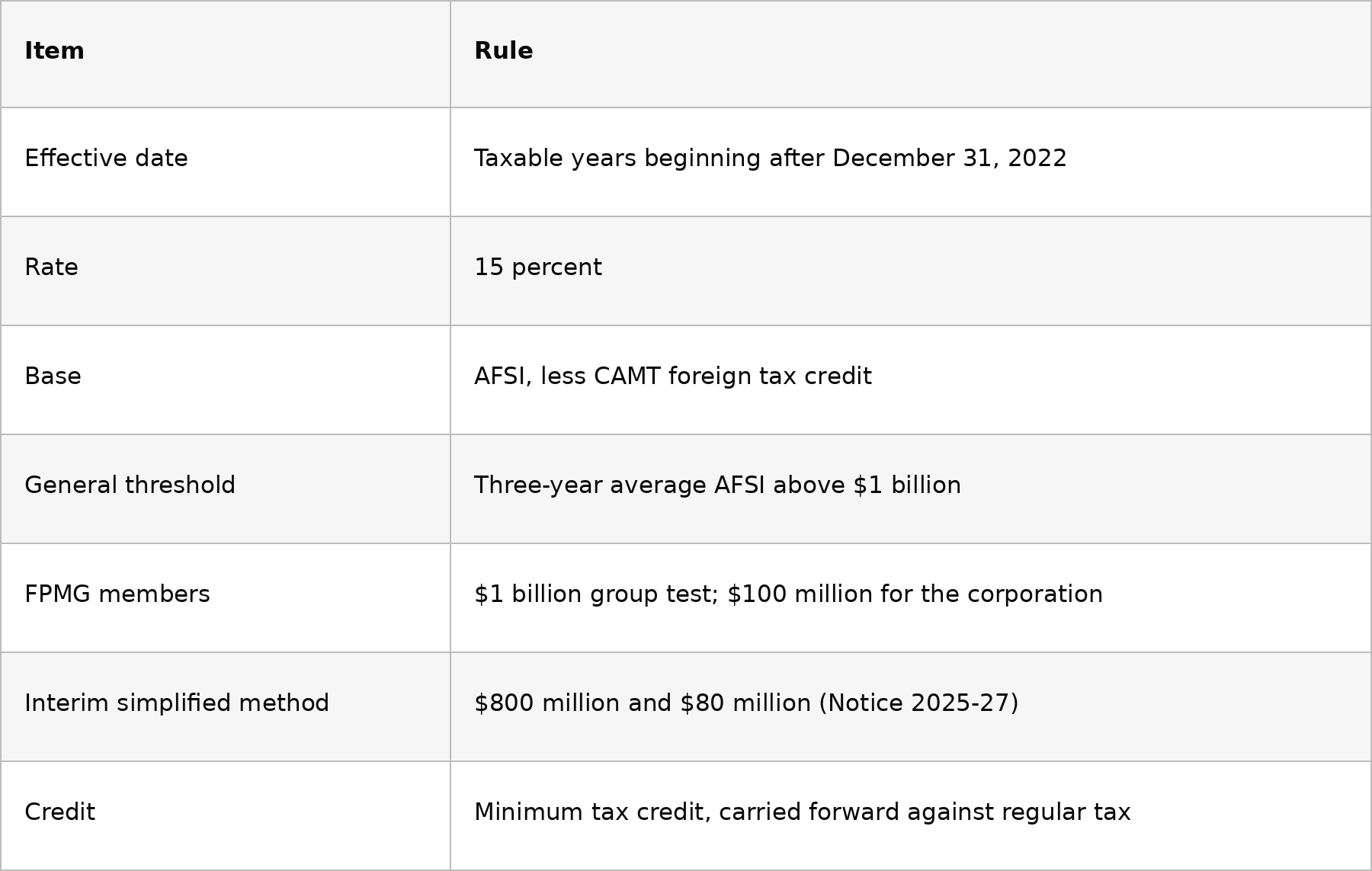
The Inflation Reduction Act of 2022 (Pub. L. 117-169) added the CAMT to sections 55, 56A and 59 of the Code for taxable years beginning after December 31, 2022. The tax is 15 percent of AFSI, reduced by the CAMT foreign tax credit. Congress introduced it to address large corporations reporting substantial profit to shareholders while owing little regular tax. Because the base begins with financial statement income, the CAMT is sensitive to accounting policy in a way the regular tax is not.

A corporation is an applicable corporation if its average annual AFSI over a three-taxable-year period exceeds $1 billion. For a member of a foreign-parented multinational group (FPMG), two conditions apply:
Related corporations are generally aggregated under the controlled-group rules of section 52, with modifications, so the test is applied across the group rather than entity by entity. Once a corporation becomes applicable, it generally remains so until a statutory cessation event occurs.
Notice 2025-27 provides an optional interim simplified method that lowers the thresholds to $800 million and $80 million. A corporation below those figures may conclude it is not applicable, provided it was not applicable in a prior year. Corporations above them must apply the full test.
The CAMT liability is the excess of the tentative minimum tax over the sum of regular tax and the base erosion and anti-abuse tax. The tentative minimum tax is 15 percent of AFSI less the CAMT foreign tax credit. Where regular tax exceeds the tentative minimum tax, no CAMT is due.
AFSI starts with net income or loss reported on the applicable financial statement, generally the consolidated statement. It is then adjusted. Federal income taxes are disregarded, and specified adjustments apply under section 56A.
Financial Statement Conventions: Consolidated reporting, equity-method income and the choice of statement can all affect the base, as can differing accounting and tax years.
Depreciation: AFSI is generally reduced by regular tax depreciation on section 168 property. Section 56A(c)(13) does not reach repair costs, and Notice 2026-7 addresses that gap by interim adjustment.
Partnerships: A corporate partner takes into account its distributive share of partnership AFSI. Notice 2025-28 offers simplified alternatives, including a top-down election, a taxable-income election for smaller interests and a fuller subchapter K method. Choices among them may constrain one another.
Pensions and Other Items: Specific adjustments address pension and certain other items. Treasury also holds regulatory authority under section 56A(c)(15) to adjust AFSI to prevent omission or duplication, which is the basis for much of the interim relief.
Credits: Federal income tax expense is disregarded in AFSI, and general business credits may offset CAMT liability, subject to limitations. Treatment of transferable and direct pay energy credits is addressed in the 2024 proposed regulations.
Financial Statement Net Operating Losses: FSNOLs arising in years ending after December 31, 2019 may reduce AFSI, subject to an 80 percent limitation. Notice 2025-46 addresses their treatment for acquiring companies.
CAMT paid generates a minimum tax credit that carries forward indefinitely. It may be used against regular tax to the extent regular tax exceeds the tentative minimum tax in a later year. Corporations expecting recurring CAMT exposure may therefore model the credit’s recovery as a separate asset.
Enacted law. The IRA provisions remain in force. The One Big Beautiful Bill Act (Pub. L. 119-21) did not repeal the CAMT but affected it indirectly by restoring immediate domestic research expensing under section 174A. It also added a CAMT adjustment for intangible drilling costs beginning in 2026, on which Notice 2026-7 offers no guidance.
Proposed regulations. REG-112129-23 (89 Fed. Reg. 75062) was published September 13, 2024. The Treasury has announced its intent to partially withdraw it and issue revised proposals. Officials indicated earlier this year that the revised proposals may arrive by the end of 2026.
Interim guidance. Reliance is generally available until final regulations are published, subject to consistency and disclosure requirements.
Notice 2026-7 includes a transition option for tax years beginning before February 18, 2026. Foreign tax credit rules for the CAMT remain largely unaddressed.
The CAMT can raise cash taxes without changing the regular tax provision, and it may alter the effective tax rate through credit recognition and valuation assessments. Forecasting benefits from a three-year view, because applicability depends on a rolling average and adjustment elections have lasting consequences.
Disclosure: Earnings commentary and investor communication may require explanation of the gap between regular and minimum tax.
Interactions deserve attention. Immediate domestic research expensing lowers regular tax but widens the gap with book treatment, which Notice 2026-7 partly bridges.
On Pillar Two, the OECD’s side-by-side package of January 5, 2026 generally exempts U.S.-parented groups from the income inclusion and undertaxed profits rules for fiscal years beginning on or after January 1, 2026. Qualified domestic minimum top-up taxes remain applicable, and 2024 and 2025 obligations are unchanged. The CAMT and Pillar Two use different bases and do not operate as substitutes.
Over the next twelve months, matters to watch include publication of revised proposed regulations, further interim notices, treatment of the foreign tax credit and intangible drilling cost adjustments, the status of any 2026 estimated tax relief, legislative proposals affecting the tax, and implementation of the side-by-side package by Pillar Two jurisdictions.

Wall & Genève is a finance and advisory firm serving investment banks, asset managers, hedge funds and broker-dealers. Precise work, handled with discretion.
Copyright © 2026 Wallandgeneve All Right Reserved.