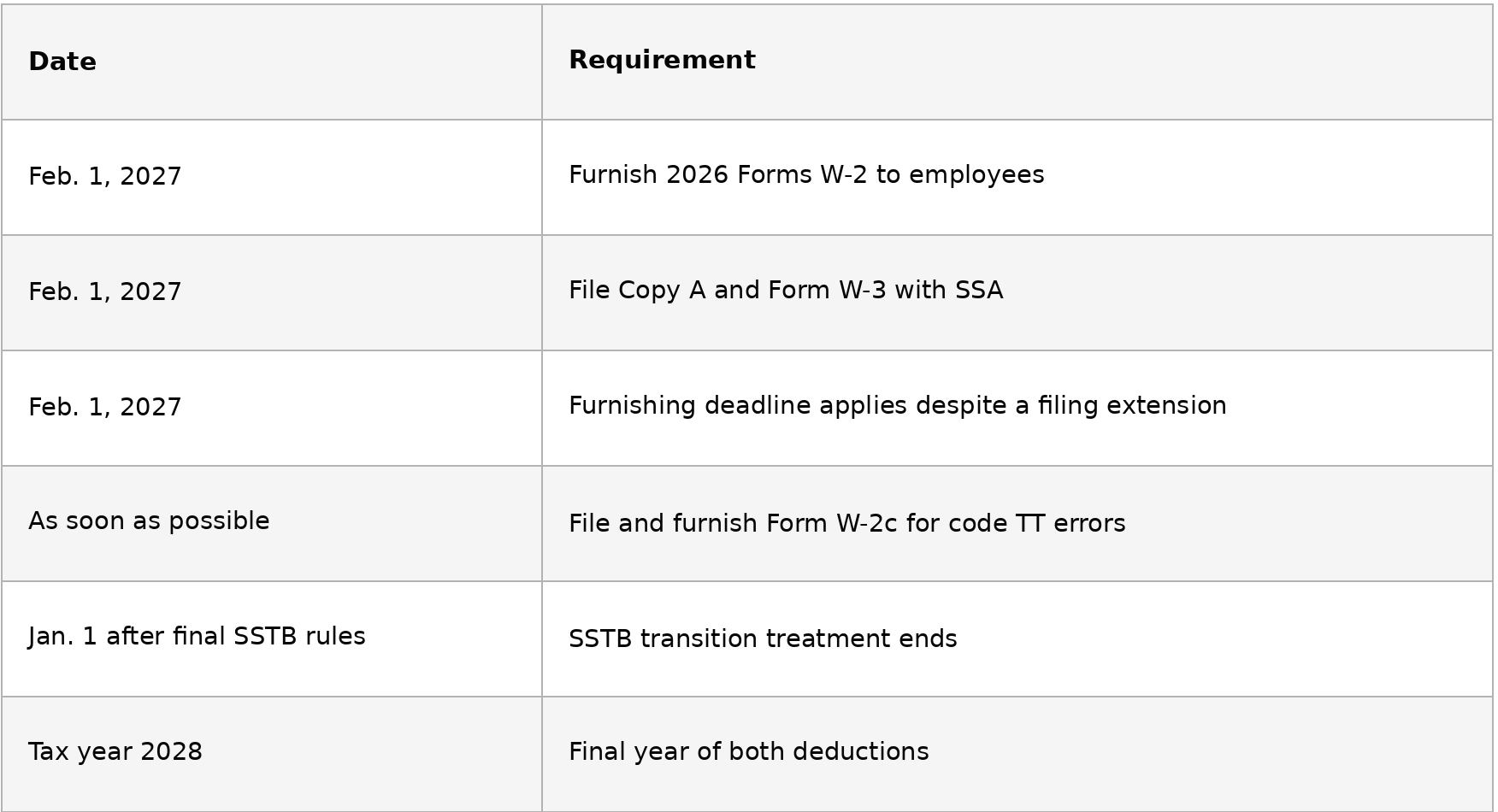
Beginning with 2026 wages, employers must report qualified overtime compensation and cash tips in dedicated Form W-2 fields. The 2025 penalty relief does not extend to 2026. Employees may deduct qualified overtime only if it appears on a properly furnished W-2. Forms are due February 1, 2027, so data mapping and system configuration belong in the final 2026 payroll cycles.
The 2026 General Instructions for Forms W-2 and W-3 add three elements:
Former box 14 content moves to box 14a. Box 12 also carries new code TA for employer Trump account contributions, which is outside the scope of this article.
Workers who are employees under the FLSA but treated as contractors for tax purposes are reported on Form 1099-NEC (boxes 1b, 1c and 1d) or Form 1099-MISC (boxes 13a, 13b and 14). FS-2026-13 describes this situation as rare. Form 1099-K was also revised for tips.
Payroll must therefore capture the FLSA workweek, FLSA hours worked, the regular rate, each employee’s overtime-eligibility status, tip receipts by source, and an occupation code for every tipped role.

Qualified overtime is overtime compensation required by section 7 of the FLSA that exceeds the employee’s regular rate. For most employees, the IRS formula is FLSA hours above 40 in the workweek, multiplied by one-half, multiplied by the FLSA regular rate.
The IRS illustrates the point with an employee earning $20 per hour who works 50 hours and is paid double time. Only $100 is qualified overtime, because the FLSA required only the one-half premium.
Employers report the full qualified amount in code TT even where it exceeds the deduction cap. The IRS example shows $30,000 reported against a $12,500 limit.
Common pitfalls include:
A qualified tip is a voluntary cash or charged tip received in an occupation that customarily and regularly received tips on or before December 31, 2024. Tip-sharing arrangements such as pools are included. The final regulations list more than 70 occupations in eight categories, from Beverage and Food Service to Transportation and Delivery.
Mandatory service charges are not qualified tips unless the customer may disregard or modify them. An automatic 18 percent charge for large parties does not qualify.
FLSA tip rules operate separately but affect the data. Under DOL guidance, an employer taking a tip credit may require pooling only among customarily tipped employees. An employer paying the full minimum wage may include non-tipped employees in a pool. Managers and supervisors may not receive tips from a pool. A pool participant whose occupation is not on the Treasury list would be coded “000,” in the firm’s analysis.
Pitfalls include commingling service charges with tip fields, assigning occupation codes inconsistently across entities, and failing to reconcile point-of-sale data to payroll. Treatment of allocated tips (box 8) relative to code TP should be confirmed in the W-2 instructions. Section 225 excludes qualified tips from qualified overtime, so tip-credit employees warrant separate review of the regular rate.
Incorrect or incomplete returns and statements are subject to penalties under sections 6721 and 6722, with reduced penalties for timely corrections. Penalty amounts for returns due in 2027 should be confirmed.
Employee-side consequences are significant. An employee may not claim qualified overtime above the amount in code TT, and a substitute Form 4852 does not cure an omission. Understated amounts therefore generate correction requests. Overstated amounts are limited to the amount actually paid.
Misclassification compounds exposure, because an incorrect FLSA status affects both wage-hour liability and reporting. Valid employment-eligible Social Security numbers are a condition of the employee deduction. Multi-state employers face varying conformity. Ballotpedia reported in May 2026 that 19 of 41 broad income tax states had conformed to the tips deduction.
Source: IRS.gov

Wall & Genève is a finance and advisory firm serving investment banks, asset managers, hedge funds and broker-dealers. Precise work, handled with discretion.
Copyright © 2026 Wallandgeneve All Right Reserved.